I’ve loved
hamsters since I was a little girl. They’re wonderful, adorable, fun little
animals. My home doesn’t feel complete without one. However, that doesn’t mean
they’re for everyone, especially young children, and they are absolutely not
suitable for a classroom pet.
THE BASICS
Hamsters are most
active in the late evenings and early mornings, meaning children may rarely see
them. Waking them up during the day is very stressful for them and should be
avoided. When they’re awake, they can be loud and keep children (and you!)
awake.
Hamsters are
fragile prey animals. It can be difficult to earn their trust and bond with
them, and this process must be taken at their pace while respecting their
boundaries. If they are startled or frightened, they may bite to defend
themselves and this can be painful. Being bitten can be upsetting for children,
and if they flinch, they could accidentally drop and injure the hamster. All
hamsters are different, and some may never enjoy being handled. Some species
are nippier than others.
Hamsters’ housing
needs can be expensive to meet. People might argue that it’s “just a hamster”
and the guidelines are excessive. While hamsters’ lives may be short, they still
deserve the best life we can provide them. It’s the only life they get. If
you plan to ignore ethical guidelines, do not get a hamster. This includes
committing to keeping them for their lifespan, which is about two years
depending on the species.
The cost of
veterinary care must also be considered. Hamsters may require a vet if they
become unwell or for end-of-life care to ease their passing. Because they are
exotic pets, veterinary care can be significantly more expensive.
Most species of
hamsters are solitary animals that MUST be housed alone. Putting them together
even for a short time can lead to nasty and dangerous fights. Syrian hamsters
and Chinese hamsters are strictly solitary. Some species of dwarf hamsters can
be housed together under special circumstances with experienced keepers.
There are five
domesticated species. Syrians, also known as teddy bear or golden hamsters, are
the largest and most common. Dwarf and Chinese hamsters are smaller and quicker.
Dwarf hamsters sold in pet stores are hybrids of two species and it’s
considered highly unethical to breed them.
KEY CARE POINTS
- Store-bought cages are inhumanely
undersized. Although ethical guidelines vary by country, the ideal size is 5000
square cm/777 square inches of continuous floor space (not levels or
connected cages). That’s 100x50 cm or ~40x20 inches. Canada’s ethical minimum
is 80x50 cm/600 square inches. Female Syrians may require even larger. Keep
reading for alternatives to store-bought cages.
- Hamsters are
ground dwellers who burrow. They need at least 8 inches of bedding and enclosures
should be approximately 50 cm/20 inches deep.
- Bar-biting, monkey-barring,
pacing, chewing the corners of the cage, and trying to escape are signs of stress due to inadequate care, such
as an undersized enclosure without enough bedding or enrichment.
- Pine and cedar
shavings are toxic to rodents’ respiratory systems. Use aspen, hemp, or
shredded paper products instead. Don’t buy fluffy nesting material (cotton,
kapok) because it can become wrapped around limbs and cause internal blockages.
- Hamsters require a sandbox in their enclosure. They use it for bathing and some will even litter train themselves in it. You can buy rodent sand, or you can buy reptile sand provided it doesn't contain dyes and is calcium-free.
- Wheel diameters
should be at least 10-12 inches for Syrians and Chinese and 8 inches for
dwarfs. Running surfaces must be made of solid plastic or wood. Ridges, holes,
and rungs can cause injuries.
- Exercise balls are
unsafe and should not be used.
- Hamsters sold in
pet stores come from inhumane rodent mills and are often rife with health
issues. Please consider adopting from a shelter or rescue instead. There are a
few ethical breeders out there but do your research first.
- Local note for Sault Ste. Marie: Both of my
hamsters are from our humane society, but they’d been placed at the Trunk Road
Pet Valu for adoption. This was clearly indicated on the aquariums in which
they were housed and the transaction was processed separately. I wish all pet
stores would do this instead of trucking in animals from rodent mills.
HOUSING
Research has led
to an evolution in ethical hamster care. Unfortunately, pet stores and the manufacturers
of pet supplies continue to sell products that range from inhumane and unethical
to dangerous. The same applies to all rodents kept as pets.
With very few
exceptions, hamster cages are cruelly undersized. The ideal minimum size is 5000 square
cm/777 square inches of continuous floor space. That’s 100x50 cm or ~40x20 inches.
Canada’s ethical minimum is 80x50 cm/600sq inches. This cannot be divided into
levels or separate cages connected by tubes. Cages with extra levels are
unnatural (hamsters are ground dwellers) and dangerous because the hamster can
fall and injure itself. Plastic tubes are too narrow for Syrians and provide
inadequate ventilation. Tubes that run outside the cage can become disconnected,
allowing the hamster to escape.
Hamsters have an
instinctive need to build burrows that require at least 8 inches of bedding, but
30+ cm is even better. Enclosures should be around 50 cm/20 inches deep. The more
you compact the bedding, the better the burrow holds. Most cages can’t
accommodate that much bedding because they’re built with shallow trays and
metal bars.

Photo: My Syrian hamster
Tyrion poking his head up from his burrow. He didn’t see his shadow, predicting
a warm holiday season.
A few commercial cages
meet requirements, including some (but not all) made by Niteangel, PawHut, and
Bucatstate. They’re available online through Amazon, Wayfair, etc. Alternatives
are aquariums (minimum 40-gallon breeder), custom-made, and the relatively
inexpensive bin cage.
Bin cages are made
from clear, colourless storage totes. The largest such bin I’ve found is the
Sterilite 189L, which you can find at Walmart for under $50. Even that is a bit
small in my opinion, but it’s much more humane than anything from a pet store.
Obviously, your hammy needs to breathe, but you don’t want to worry about
Houdini escaping. Cut large openings in the lid and attach rodent-proof wire
mesh, NOT chicken wire. I fasten mine using zip ties. You can find steel mesh
with half- or quarter-inch openings at Home Depot for about $25.
I have 3 different
types of enclosures in my home (see photos). My rescued feeder mice live in the
189L bin cage. One of my Syrians lives in a 75-gallon aquarium, while the other
lives in an enclosure I built from IKEA Komplement shelves. You can find ideas
for custom builds on YouTube and Pinterest.
UPDATE July, 2026: My current hamsters, two female Syrians named Lilith and Bela, live in Bucatstate 3.0 120cm enclosures and I cannot recommend them highly enough. They measure 119x60cm (7140 square cm) / 47x23.6in (1109 square inches). Both were showing signs of stress in their custom-built IKEA enclosures that were roughly 850 square inches, behaviours that immediately stopped in their Bucatstates. Female Syrians are notoriously difficult to please.
BEDDING
Do not use pine or
cedar! They’re toxic to rodents’ respiratory systems. Aspen and hemp are safe
and best mixed with unscented paper-based bedding that’s readily available from
pet stores and online. Paper bedding can also be used alone. I prefer the white
paper products to avoid dyes. This also makes it easier to spot dirty bedding
and to keep an eye on my hamsters’ health (e.g. blood in urine).
Do not buy the fluffy,
cottony nesting material! It can get wrapped around little toes, stuck in cheek
pouches, and cause fatal intestinal blockages. Hamsters will use their bedding
for their nest, or you can tear up toilet paper (not Kleenex, which can block
their intestines).
How often you
clean your hamster’s enclosure depends on its habits. Victoria Raechel has an excellent
YouTube video on the topic. In fact, she’s an excellent source of information
in general.
https://www.youtube.com/watch?v=JFep1JycdVA
WHEELS/EXERCISE
It’s no surprise
that undersized cages come with undersized wheels. These cause uncomfortable
spinal curvature and can lead to spinal problems. Your hamster’s back should be
flat and straight when running on its wheel. Syrian and Chinese hamsters need
wheels that are at least 10 inches in diameter, but 12 inches is even better. Dwarf
hamsters need an 8-inch. Make sure the running surface is made of solid plastic
or wood. Anything with holes, rungs, or openings can cause injuries.
Saucer discs should
be avoided because they cause the hamster to run at an unnatural angle.
Do not use
exercise balls! Hamsters have poor vision and mostly navigate the world using smell.
Balls block most of the scent available to them. Because they’re prey animals,
being in a ball is frightening—there’s nowhere to hide. Also, their legs and
feet can get caught and injured in the ventilation slats.
The best and
safest source of exercise and boredom-busting outside their cage is a small-animal
playpen or a hamster-proof room in which they can roam free. Even a dry,
plugged bathtub will work. Sitting in it with them can help with the
bonding/taming process. Fill the play area with toys (see next section) to
enrich the environment. Use a container to securely transport them between
their enclosure and the play area.
CLUTTER IS GOOD!
Active and curious
little creatures, hamsters become bored quite easily. Their cages need plenty of
enrichment items and toys. At least two hideaways are a must, as is a sand bath.
Hamsters like to use sand for bathing. Some will even potty-train themselves in
it. Be sure the sand you buy doesn’t have added calcium or dyes and is low dust. I prefer Reptisand in desert white. You can buy play sand (Home Depot, etc.), but it
must be baked first. Aim for a sandbox that is roughly 20x30cm (8x11.5inches), the size of an A4 piece of paper. It should also be roughly 10cm/4inches deep. Because it's heavy, set it on a shelf with stilts.
Add bridges, huts,
branches (make sure it’s a hamster-safe species—Exo Terra terrarium branches
are great!), natural cork products (flat pieces or rounds), dried sphagnum
moss, and so on. They also enjoy different substrates to dig in, such as
shredded coconut husk. Many of these items can be found in the reptile section.
If you aren’t sure if it’s safe for hamsters, ask or check (reputable!) online
sources. Freeze natural products for at least 48 hours to kill any unwanted
hitchhikers. Avoid toys and decorations made of resin because they can have
sharp edges, especially if chewed on.
Sprays (dried plants) are also an excellent source of enrichment. Some examples are flax and sorghum. Some hamsters eat them, some don't, but they not only give hamsters something to sniff and chew, they also give them a sense of security because they add natural cover. You can find them on Amazon, Etsy, and in specialty online hamster shops. Be sure to freeze them for at least 48 hours first!
A note about bendy
bridges. Most have gaps between sections in which legs and feet can get caught
and injured. Either invest in a more expensive brand that has uniform pieces or
use non-toxic school glue and sphagnum moss to fill in the gaps.
Check YouTube or
Pinterest using the keyword “hamsterscaping” for enrichment ideas. This is another excellent video from Victoria Raechel that demonstrates
how an enclosure should be set up.
https://youtu.be/kaVqfcZTA7E?si=I36Y5ZTSIm1KnBT2
FOOD
Foods with timothy
hay as the main ingredient aren’t recommended. Your hamster should eat a
combination of seed mix and lab blocks (nugget-looking things). Supplement
these daily with fresh, clean produce. Kale, Romaine lettuce, cauliflower,
broccoli, bell peppers, zucchini, cucumber, and peas are favourites in my
house.
The Ontario
Hamster Club is another excellent source of information and has an extensive
list of safe and unsafe foods as well as a list of recommended commercial foods.
You can find them on Instagram, their Facebook page, and connect with fellow
hamster lovers through their Facebook group.
https://www.facebook.com/groups/ontariohamsters
These are my
preferred foods:
- Versele-Laga
Crispy Muesli seed mix
- Versele-Laga
Nature Hamster seed mix
- Kaytee
Forti-diet lab blocks
QUESTIONS?
Feel free to ask. If I don’t know
the answer, I’ll do my best to point you in the right direction.
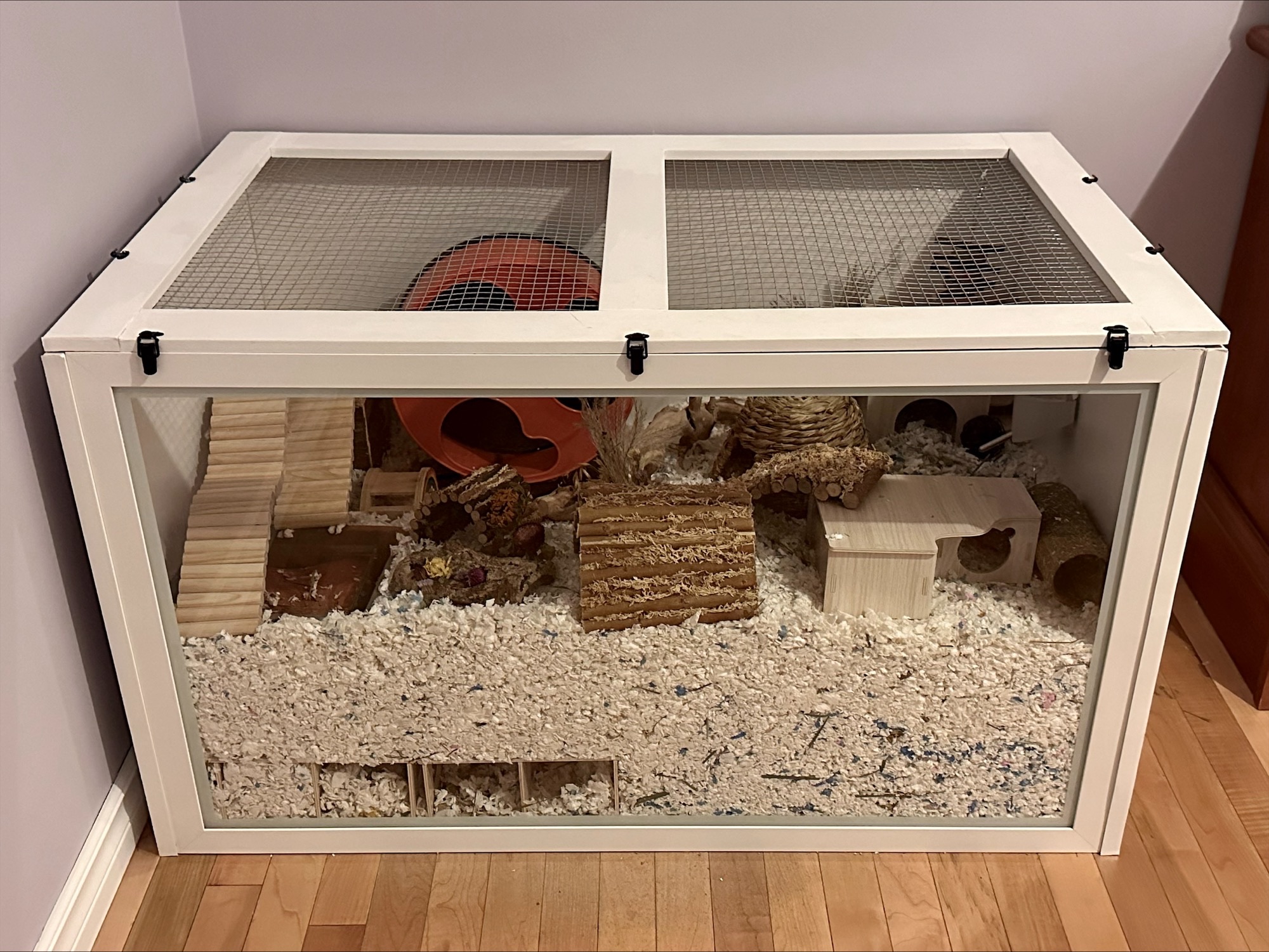
Photo: The enclosure I
built for Misha Smallins using IKEA Komplement shelves and a homemade lid using
materials from Home Depot and Amazon.
Photo: The 189L
Sterilite bin that houses my rescued feeder mice (Phoebe, Rachel, and Monica)
Photo: Tyrion Hammister’s
75-gallon aquarium with Exo Terra hinged screen lid and clamps
Lilith and Bela and their Bucatstate 3.0 120cm enclosures
Many thanks to Elise Bishop from the Ontario Hamster Club for her invaluable input!